Tsai said that with the Hai Kun – a mythical Chinese shape-changing sea beast with the power of flight – "Taiwan will have three submarines with full combat capabilities" in 2025. One more locally manufactured sub is planned for 2027.
According to the Ministry of Defense, the diesel-electric Hai Kun cost US$1.54 billion and will go by the name “Narwhal” in English.
Speaking in a hangar in the southern city of Kaohsiung, where the massive new sub was mounted, draped with the Republic of China flag, Tsai said, "Today will go down in history."
China’s nationalist tabloid Global Times said Taiwan was deceiving itself over the sub’s defensive capabilities.
“The island of Taiwan"s submarine deployment plan to block the Chinese People"s Liberation Army (PLA) from entering the Pacific Ocean is daydreaming,” it said.
But Taiwan’s Tsai, nevertheless, delivered a feisty, rousing speech to mark the launch.
“The submarine project is essential for defending Taiwan’s maritime borders,” said Tsai.
“The efforts of everyone not only set a new milestone for Taiwan"s defense autonomy but have also brought honor and pride to our navy, military and Taiwan.”
‘Vexing problem’
Taiwan’s submarine fleet has long been a vexing problem for politicians with a proactive defense agenda, given that China has never disavowed annexing Taiwan by force if peaceful unification cannot be achieved.
The Taiwanese navy has four veteran submarines – two WWII relics provided by the U.S. in the 1970s, used for training, and the other two bought second-hand from the Netherlands, dating back to the 1980s.
Taiwan originally planned to add seven domestically assembled submarines to its fleet, but at present there is no formal schedule for further assembly. With the addition of the Narwhal to the Netherlands’ vessels, Taiwan will have a fleet of three operational submarines in 2025.
Wendell Minnick, an American military expert and author of the China in Arms Substack, explained that the Hai Kun, or Narwhal, was a “prototype” by definition, because “the first submarine or ship in any navy is a prototype. The second is a test platform, and the third, maybe, will be the first operational submarine.”
Minnick added, “Whether the timeline for invasion allows them to build enough operational submarines for war is a question mark. I do salute their progress, but too little, too late.”
Asked whether he agreed with Minnick’s assessment, Dr Lin Ying-yu, assistant professor at Tam Kang University, said, “Better late than never.”
Fraught history, uncertain future
Taiwan’s indigenous submarine efforts have long been stymied by wavering support from key allies, the U.S. and European powers, all of which until recently were wary of incurring the wrath of an ascendent China.
Much of the expertise and critical components that made the Thursday prototype launch possible is due to Japanese support – Japanese experts and submarine design.
The U.S. has come to play a role more recently during the Trump and Biden administrations, as relations between China and the U.S. soured and the U.S. turned its attention to financing deterrents to Chinese expansionism in the Taiwan Strait and the South China Sea.
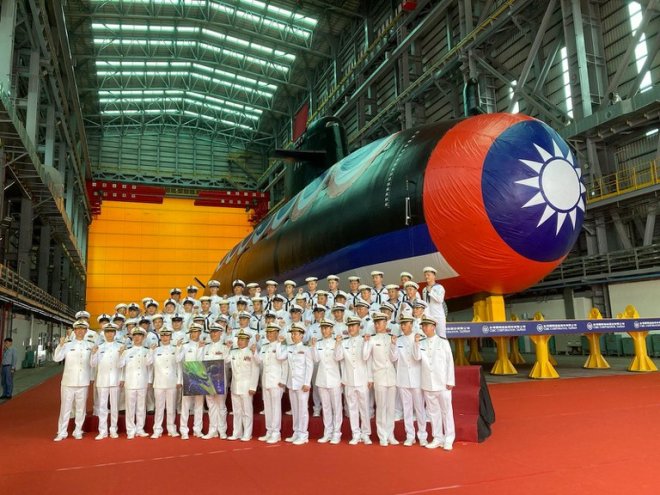 Taiwan Navy officers stand in front of the Hai Kun, Taiwan’s first domestically produced submarine. Credit: RFA
Lin of Tam Kang University justified the home-grown submarine effort, arguing that the PLA Navy was growing its fleet at such pace that Taiwan had to find ways to protect its territorial integrity.
“Submarines … can be used against the entire PLA Navy but especially aircraft carriers like the Shandong, which has been operating near Taiwan,” he said. “Recently the PLA Navy has been staging a kind of blockade around Taiwan so we should try to deny them access.
“We need to make the first step and help ourselves before expecting other countries to step in and help us,” Lin added.
Jyh-Shyang Sheu, assistant research fellow at the Taiwan Institute for National Defense and Security Research said the newly developed submarine and its future iterations would provide Taiwan with much needed advantages due to “stealth.”
Locating enemy submarines and carrying out anti-submarine warfare is a massive time and resource sink for attacking forces, said Sheu, adding that this would provide Taiwan with strategic advantage.
He added, “With land attack cruise missiles, that could also help Taiwan [achieve] the defeat of the PLA’s critical assets … from unpredictable places.”
The catch, the military researcher admitted, is the cost.
“Taiwan needs to protect itself, he said, “But submarines are extremely expensive, so we need to organize that.”
American military analyst Minnick, who worries that time is running out for Taiwan to “build enough operational submarines for war,” also worries that Taiwan’s submarine program may create additional problems if and when war breaks out.
“The U.S. Navy didn’t want Taiwan to build subs,” says Minnick. “There are already too many subs in the water already to keep track of … too much underwater congestion … making it too easy for the U.S. Navy to … [target] the wrong boat.”
Says Minnick, “China has around 60 types of submarines.” Their role is not to attack Taiwan “but to sink U.S. ships.”
“The U.S. Navy does not want the burden of trying to tell the difference between Taiwan and Chinese subs in the water,” he said.
Edited by Mike Firn and Elaine Chan.