These activities, known as “transnational repression,” show the extent that officials from foreign governments will go in order to shape public views of their policies. Officials from Beijing and other capital cities spy on individuals in the United States and try to crush criticism of their policies through extortion, death threats and even physical assaults, according to the authors of the report.
The report, which examines the “harassment of dissidents and other tactics of transnational repression,” was compiled by researchers from the Government Accountability Office (GAO), a nonpartisan investigative unit of the U.S. Congress.
Yet the U.S. does not have laws that specifically criminalize this type of behavior. As a result, law-enforcement officials have relied on a variety of existing statutes, such as those that prohibit money laundering, in order to stop the offenses. FBI officials told the GAO that “gaps in existing law” make it harder to fight against the Chinese government’s attempt at political repression here in the United States.
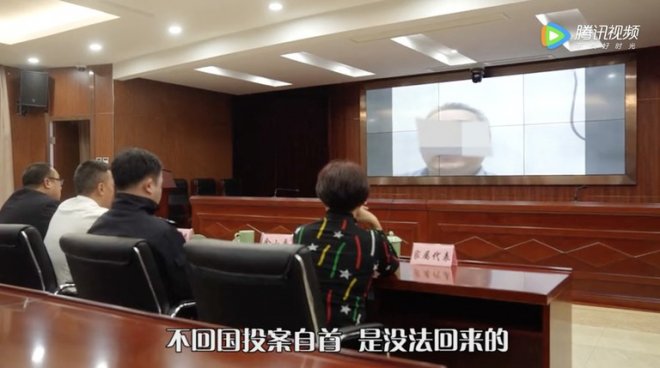 A screenshot of a video shows members of the “Qingtian Overseas Chinese Service Center Madrid” trying to persuade a criminal suspect to return to China. The man"s relative in China was summoned by authorities to join the video meeting, sitting beside officials and with a “Family Representative" name tag. Credit: Safeguard Defenders
In one example, as the FBI officials explained to the authors of the report, U.S. statutes used to crack down on this type of repression were written before the internet was created. This makes it harder for prosecutors to bring a case against an individual outside of the United States who works to intimidate U.S. residents.
Analysts say that the use of cyber intimidation and repression is one of the biggest challenges for law enforcement today. “We struggle with this not only in our own country but also with the foreign governments engaging in cyber repression,” said David Fidler, a senior fellow at the Council on Foreign Relations.
Chelsa Kenney, the director of the GAO’s international affairs and trade team, said that one of the problems for U.S. officials attempting to combat transnational repression is there is no standard definition for what it entails. Local police called to a crime scene may not necessarily consider that the perpetrators are actually living abroad, she said, or “that the crime could have been directed by a foreign government.”
The report recommends that U.S. officials at the Justice Department and other federal agencies take steps “to enhance the common understanding” of transnational repression and to examine “gaps in legislation” needed to address the problem. The authors of the report also encourage the heads of various federal agencies to work closely together to address transnational repression.
"Coercion by proxy"
The subject of transnational repression in its various guises has come under scrutiny in recent years. The activities of authoritarian leaders have expanded, according to experts, in part through new methods of tracking people abroad. The Russian government has attempted to poison its critics, according to the U.S. authorities, and the Chinese government has tried to force dissidents to return home to face punishment.
One example of transnational repression noted by the authors of the report is a tactic used by Chinese officials known as “coercion by proxy.” Specifically, family members of six U.S.-based journalists reporting on human rights abuses in Xinjiang for Radio Free Asia were thrown in prison in 2021.
"There are still over 50 China-based family members of RFA Uyghur staff missing," said Rohit Mahajan, RFA"s chief communications officer.
A spokesperson for the Chinese Embassy in Washington did not respond to a request for comment.